


Dry Needling: What is it and Who can Benefit?
By: Paul Messner, PTMarch 30, 2026
Editors: Ryan Davey, PhD and Lindsay Davey, MScPT, MSc, CDT
Pain and persistent tightness can affect your quality of life. When stretching, massage, and/or exercise alone doesn’t provide relief for tense muscles and pain, dry needling can be a highly effective solution. It is now being used as a primary tool in physiotherapy clinics in order to resolve musculoskeletal issues more quickly, and offers a meaningful option to those with chronic conditions. Dry needling is a safe, evidence-based technique used by certified Physiotherapists to reduce pain and restore movement through what is known as trigger point therapy.
What Are Trigger Points?
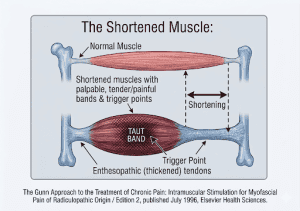
Trigger points, also known as “muscle knots”, are taut bands in the muscle with increased nerve activity and local inflammation. They can increase pain, stiffness, weakness and refer pain to surrounding areas of the body. They also increase nociception, which are pain signals that travel to the brain. Muscles with trigger points can become shortened, and in turn exerting extra pulling forces on the structures they connect to. This can increase joint pressure, tendon tension and compress local nerves in the area.
What is Dry Needling?
Dry needling is a skilled technique where a thin, sterile acupuncture needle is inserted into a trigger point in the muscle. A local twitch response (an involuntary and quick contraction of the muscle) occurs when the needle stimulates the trigger point. This reflex contraction of the tight muscle resets the abnormal muscle activity, decreases pain and relieves tension. The needles do not stay in the body like with acupuncture – once a local twitch response is elicited, the needle is removed.
Following a comprehensive assessment to determine the source(s) of your pain, dry needling is an effective tool that can be “integrated” into an overall treatment plan that would include other physiotherapy approaches such as hands on manual therapy, shockwave therapy, exercise programming, and education.
How Does it Work So Quickly?
In a nutshell, dry needling reduces pain through multiple neurophysiological effects, causing less pain signals to travel to the brain. Researchers have found that dry needling causes a decrease in inflammatory chemicals (substance P and calcitonin gene-related peptide (CGRP), specifically), immediate increased oxygenation and blood flow to the area, and an improved pain pressure threshold at the site. Furthermore, dry needling causes increased endorphin release, which are the body’s natural pain inhibiting chemicals, thus causing the rapid decrease in the sensation of pain. (Ref 1)
The pain signals coming from a trigger point to the brain can get “stuck on”, especially evident in chronic pain. Dry needling is analogous to pressing the ‘reset button’ on a pain signal that has been stuck in the ‘ON’ setting. Through deactivation of the trigger point and loosening of the affected muscle, there is significant reduction in pain and tension in the affected muscles. Reduced pain and improved mobility (not only in the muscles themselves but also in the adjacent joints!) are the goals of dry needling, and the primary reasons that many Physiotherapists find it such a useful tool to incorporate into their treatments.
What Conditions can Benefit from Dry Needling?
Muscle Pain from Trigger points:
A systematic review measured benefit from dry needling in multiple body areas showed a broad applicability of dry needling treatment for multiple muscle groups. (Ref 2)
Jaw Pain:
A systematic review found dry needling to be a highly effective modality for reducing pain intensity and enhancing functional outcomes in Temporomandibular Joint Disorder cases. (Ref 3)
Low Back Pain:
A systematic review showed evidence that dry needling, especially if associated with other therapies, could be recommended to relieve the intensity of low back pain. (Ref 4)
Headaches:
A systematic review showed that dry needling could significantly improve headache frequency, health-related quality of life, trigger point tenderness, and cervical range of motion in Tension Type headaches and Cervicogenic headaches. (Ref 5)
Shoulder Pain:
A systematic review suggests positive effects of dry needling for pain intensity and pain-related disability in non-traumatic shoulder pain of musculoskeletal origin. (Ref 6)
Plantar Fasciitis:
A randomized controlled trial showed that dry needling can reduce pain and plantar fascia thickness in women with Plantar Fasciitis who are suffering from trigger points of the gastrocnemius and soleus muscles. (Ref 7)
Mechanical Neck Pain:
The results of a randomized controlled trial support the use of dry needling in the management of myofascial pain syndrome in people with chronic non-specific neck pain. (Ref 8)
Fibromyalgia:
A systematic review shows dry needling is effective for improving pain, disability and quality of life in the short term (up to 6 weeks) in Fibromyalgia patients. (Ref 9)
We also know that Dry Needling can provide significant improvement in the following conditions:
- Tendinopathies or tendinitis (rotator cuff, tennis elbow, golfer’s elbow, Achilles tendonitis)
- Hip pain and arthritis
- Knee pain and arthritis
- Radiculopathies (nerve pain)
How Dry Needling can Help Common Conditions:
Tendonitis
With Achilles tendonitis, trigger points in the calf muscles attached to the Achilles tendon cause these muscles to shorten, increasing the ‘pull’ forces on the tendon, and cause it to become irritated or inflamed. Dry needling the calf muscles will put the Achilles tendon on slack, allowing it to recover. This same example applies to tennis elbow. Dry needling the forearm extender muscles will unload the tendon at the elbow, reducing the tendon irritation and inflammation, allowing for recovery.
Pinched nerves
Taking the case of low back pain as an example, occasionally the nerves that exit the spine can become ‘pinched’, resulting in what is known as a radiculopathy. This can cause neurogenic pain (nerve pain) which in turn causes the muscles in the area (paraspinal muscles) to become contracted and tight, in response. These tight muscles can cause further compression at the spine, potentially not only worsening the impingement of the nerves, but also of the discs and facet joints of the spine. Dry needling can loosen the tight muscles, relieve the compression and off-load the pinched nerves, as shown in the illustration below. (Ref 10)
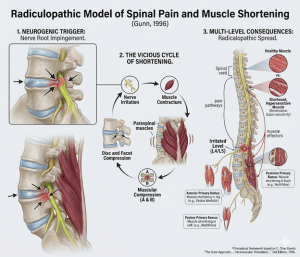
Dry needling can treat nerve pain in other areas of the body where a nerve and muscles intersect. For example, the sciatic nerve runs through the buttock (piriformis muscle) and along the back of the thigh (hamstrings muscle). With trigger points present in either of these muscle groups, it can contribute to sciatica or nerve pain in the leg. An earlier researcher in trigger point therapy, Dr. Chan Gunn, a renowned medical physician and chronic pain pioneer, first discovered that neuropathic pain can be addressed by dry needling the muscles spanning the path of the irritated nerve. This specific approach was known as Gunn IMS (intramuscular stimulation).
Arthritic joints
Myofascial overload can increase joint pain (myo refers to ‘muscle’ and fascia refers to the connective tissue that runs throughout the body). In an arthritic knee, the joint surfaces and cartilage exhibit degenerative changes from being subjected to over-compression (due to chronically shortened muscles and tight fascia). Specifically, tight quadriceps muscles at the front of the thigh will subject the knee joint to excess compression, over-loading and irritating the cartilage. Reducing trigger points in the quadriceps muscles will decrease the compression load at the knee joint. Of course, manual therapy and exercise are also essential in the management of arthritis (!) but dry needling may have a role to play to get things moving in the right direction.
What to Expect…Does it Hurt?
When the tight spot in the sore muscle is needled, it does cause an ache. The needles are thin, typically 0.3mm in width (very thin!). This is much thinner than a vaccine needle or a needle used to draw blood. If you would like to try dry needling but do not like needles or are nervous, it’s absolutely fine to start with just a single point, used briefly, and increase from there as tolerated. Eliciting a higher number of muscle twitches can have a greater therapeutic effect, but starting with a single needle or fewer muscle twitches will be more comfortable. The needles do not stay in for a prolonged amount of time like acupuncture, once the desired twitched response occurs, the needle is removed. There is a temporary soreness following the session which typically feels like a muscle ache after going to the gym. Heat over the applied area can be soothing after dry needling. Over time, patients tend to feel less sore after a session and become more tolerant to the technique. The soreness typically lasts for a few hours to 1-2 days, but rarely could persist for multiple days. There is a possibility of a minor spot of blood or bruising with dry needling (similar to acupuncture), which is not painful but as with other bruises, may be visible for up to 2 weeks. The skin over the affected area will need to be exposed. Sensitive areas are draped exposing the minimal tissue required and treatment is always conducted in private rooms. Dry needling the glute tissue is generally effective for reducing low back pain and dry needling the pecs can be helpful to decrease shoulder impingement and neck stiffness.
Summary
Dry needling has become a popular tool used in physiotherapy for a multitude of conditions, breaking the pain cycle and addressing trigger points in shortened and tight muscles, quickly and effectively. In so doing, a multitude of conditions can be helped by the incorporation of dry needling into the physiotherapy treatment plan.
Patient Testimonials:




References
1. Cagnie B, DewitteV, Brbe T, Timmermans F, Delrue N, Meeus M. Physiologic effects of dry needling. Curr Pain Headache Rep. 2013 Aug; 17(8):348.
2. Boyles, Robert, et al. “Effectiveness of Trigger Point Dry Needling for Multiple Body Regions: A Systematic Review.” Journal of Manual & Manipulative Therapy, vol. 23, no. 5, 20 Oct. 2015, pp. 276–293, https://doi.org/10.1179/2042618615y.0000000014.
3. Khayamzadeh, Mina, et al. “Dry Needling in Treatment of Temporomandibular Joint Disorders: A Systematic Review.” Clinical and Experimental Dental Research, vol. 11, no. 5, 8 Sept. 2025, pp. e70214–e70214,https://doi.org/10.1002/cre2.70214. Accessed 3 Dec. 2025.
4. Liu, Lin, et al. “Evidence for Dry Needling in the Management of Myofascial Trigger Points Associated with Low Back Pain: A Systematic Review and Meta-Analysis.” Archives of Physical Medicine and Rehabilitation, vol. 99, no. 1, Jan. 2018, pp. 144-152.e2, https://doi.org/10.1016/j.apmr.2017.06.008.
5. Pourahmadi, Mohammadreza, et al. “Dry Needling for the Treatment of Tension-Type, Cervicogenic, or Migraine Headaches: A Systematic Review and Meta-Analysis.” Physical Therapy, vol. 101, no. 5, 19 Feb. 2021,pubmed.ncbi.nlm.nih.gov/33609358/, https://doi.org/10.1093/ptj/pzab068.
6. Navarro-Santana, Marcos J, et al. “Effects of Trigger Point Dry Needling for Nontraumatic Shoulder Pain of Musculoskeletal Origin: A Systematic Review and Meta-Analysis.” Physical Therapy, vol. 101, no. 2, 19 Dec. 2020, https://doi.org/10.1093/ptj/pzaa216.
7. Moosaei Saein, Afsaneh, et al. “The Effect of Dry Needling on Pain, Range of Motion of Ankle Joint, and Ultrasonographic Changes of Plantar Fascia in Patients with Plantar Fasciitis.” Journal of Sport Rehabilitation, vol. 31, no. 3, 2021, pp. 1–6, https://doi.org/10.1123/jsr.2021-0156.
8. Cerezo-Téllez, Ester, et al. “Effectiveness of Dry Needling for Chronic Nonspecific Neck Pain.” PAIN, vol. 157, no. 9, Sept. 2016, pp. 1905–1917,insights.ovid.com/pain/jpain/2016/09/000/effectiveness-dry-needling-chronic-nonspecific/7/00006396, https://doi.org/10.1097/j.pain.0000000000000591.
9. Valera-Calero, Juan Antonio, et al. “Efficacy of Dry Needling and Acupuncture in Patients with Fibromyalgia: A Systematic Review and Meta-Analysis.” International Journal of Environmental Research and Public Health, vol. 19, no. 16, 11 Aug. 2022, p. 9904,www.ncbi.nlm.nih.gov/pmc/articles/PMC9408486/, https://doi.org/10.3390/ijerph19169904.
10. The Gunn Approach to the Treatment of Chronic Pain: Intramuscular Stimulation for Myofascial Pain of Radiculopathic Origin / Edition 2, published July 1996, Elsevier Health Sciences.
Websites for additional reference material on dry needling:
American Physical Therapy Association
Integrated Dry Needling